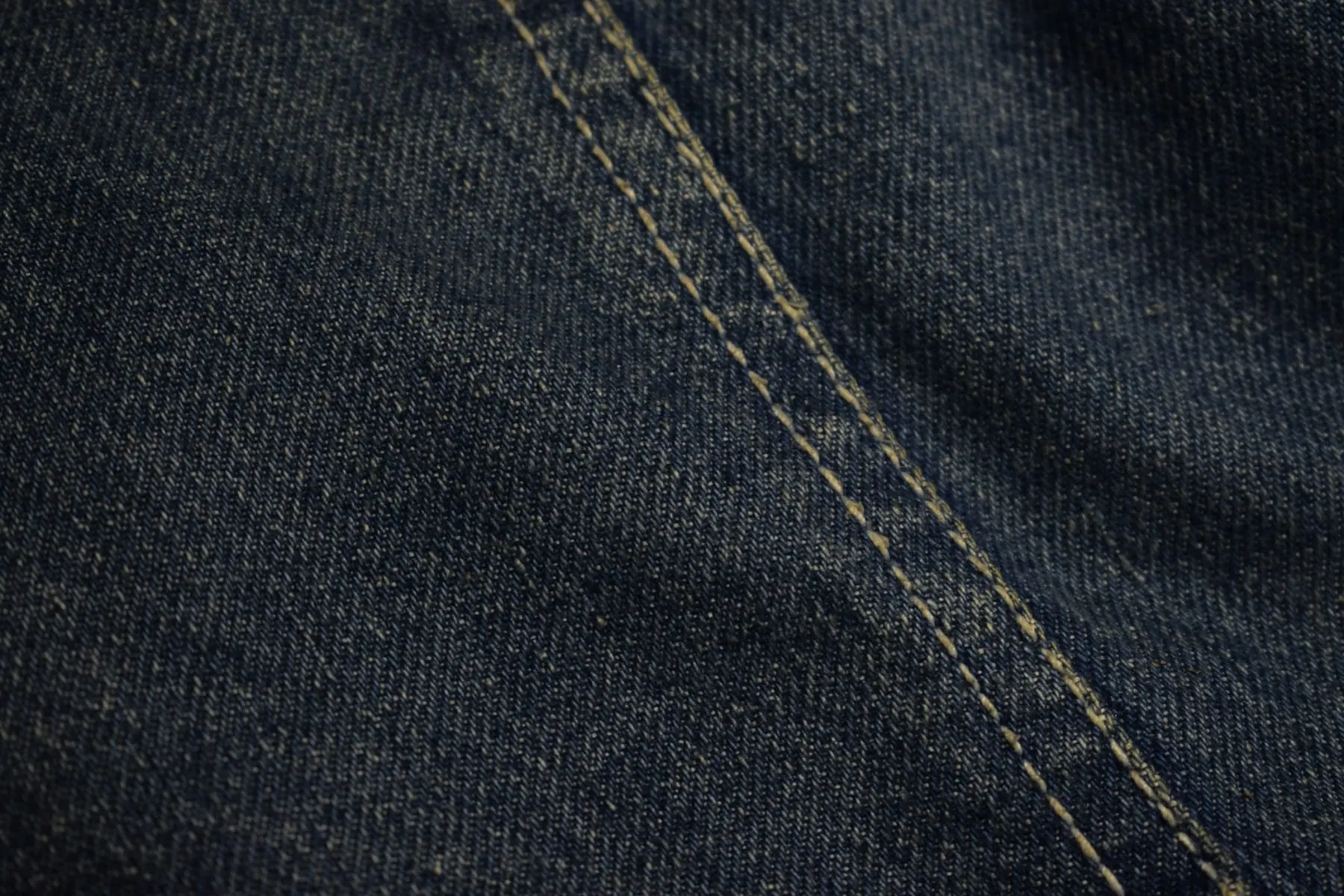
Best Fabric for Jeans: Denim Weight, Stretch, and Recovery
The best fabric for sewing jeans is cotton denim: 7–12 oz stretch denim with 1–2% spandex for skinny jeans, 10–14 oz rigid denim for straight and wide legs.
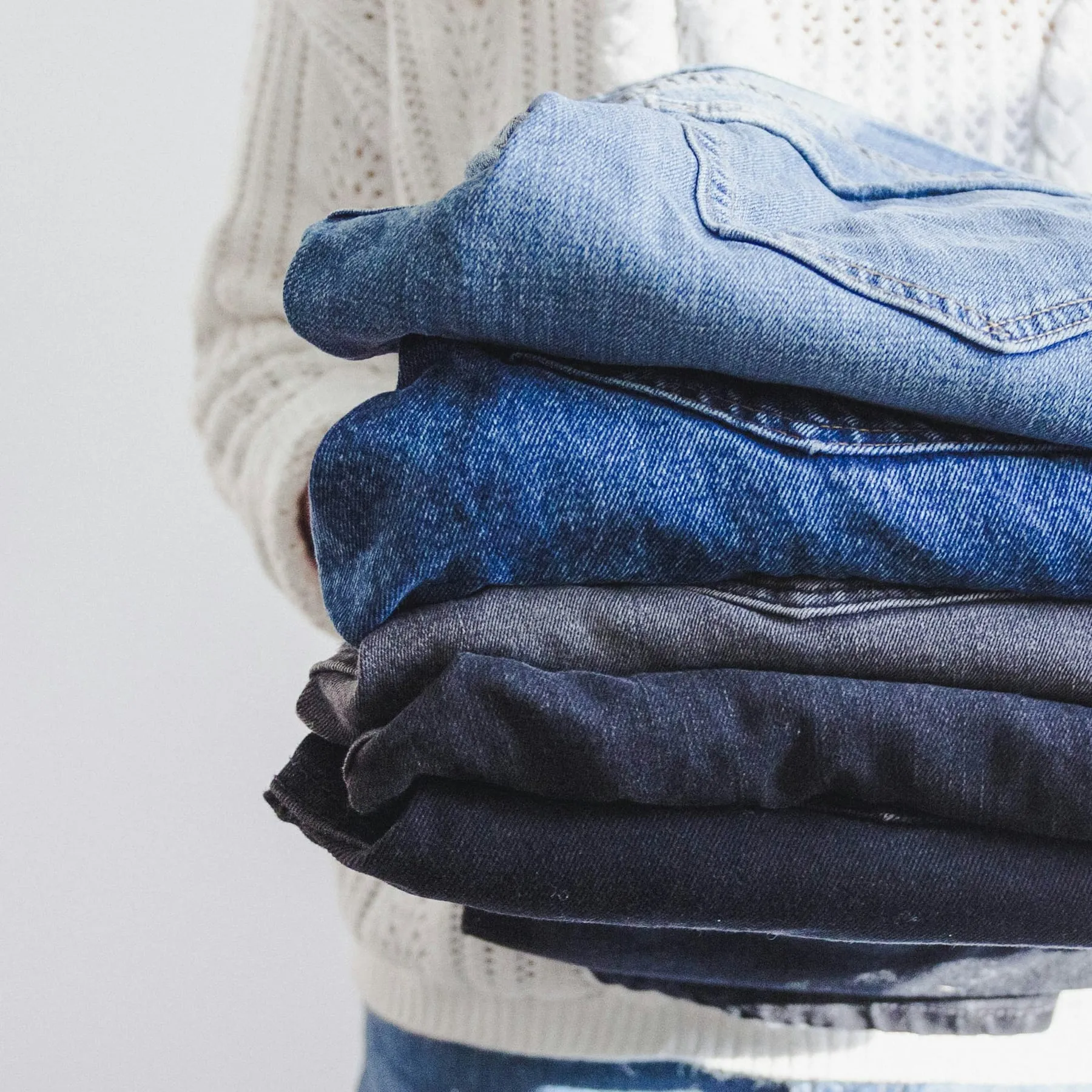
The best fabric for sewing jeans is cotton denim matched to the cut: about 7–12 oz stretch denim with 1–2% spandex (around 15–20% crosswise stretch) for skinny and close-fitting jeans, and roughly 10–14 oz rigid 100% cotton denim for straight, boyfriend, and wide-leg jeans. Always follow your pattern’s stretch requirement, and prewash the denim before cutting so shrinkage happens before you sew. Selvedge denim is a construction and width choice, not an automatic upgrade in weight or stretch.
What is the best fabric for jeans?
- Skinny or jegging-style jeans: stretch denim, about 7–12 oz, with 1–2% spandex. Lighter, drapier stretch denim suits the tightest skinny cuts.
- Slim and stovepipe jeans with stretch: stretch denim toward the heavier end (8–12 oz) so the leg has some body.
- Straight, boyfriend and tapered rigid jeans: non-stretch 100% cotton denim, about 10–14 oz. Around 11–12 oz is a good all-purpose weight.
- Wide-leg and high-waisted rigid jeans: rigid denim or another bottomweight woven (rigid twill, corduroy, heavier linen) around 10–13 oz, so the leg drapes instead of standing stiffly.
- Avoid for jeans: shirting-weight denim (around 6 oz), chambray, and very heavy denim over about 18 oz, which is hard to sew and uncomfortable to wear.
The rest of this guide explains the numbers, so you can match a listing to your pattern.
Denim weight: what “12 oz” actually means
Denim is sold by ounces per square yard (oz/yd²). A “12 oz” denim means one square yard of the fabric weighs 12 ounces, not that the finished jeans weigh 12 ounces (Heddels). If a listing gives grams per square metre instead, 1 oz/yd² is about 33.9 gsm, so 12 oz is roughly 407 gsm (Denimhunters).
Here is the catch: there are two different weight scales in use, and they don’t agree.
| Weight | Ready-to-wear jeans scale (Levi’s) | Sewing-fabric scale (Core Fabrics) |
|---|---|---|
| Under 9 oz | Lightweight | Lightweight: better for shirts, dresses, light pants |
| 9–12 oz | Lightweight | Midweight; 11–12 oz is a good all-purpose weight |
| 12–16 oz | Midweight | Heavyweight from 12 oz |
| 17 oz and up | Heavyweight | Over 18 oz is usually too thick for comfortable garments |
Sources: Levi’s denim glossary and Core Fabrics’ denim guide. Denimhunters notes there is no global standard, and that a loosely woven 13 oz can feel lighter than a dense 12 oz. So treat “midweight” on a fabric listing as a hint, and look for the actual ounce number.
Rigid vs stretch denim
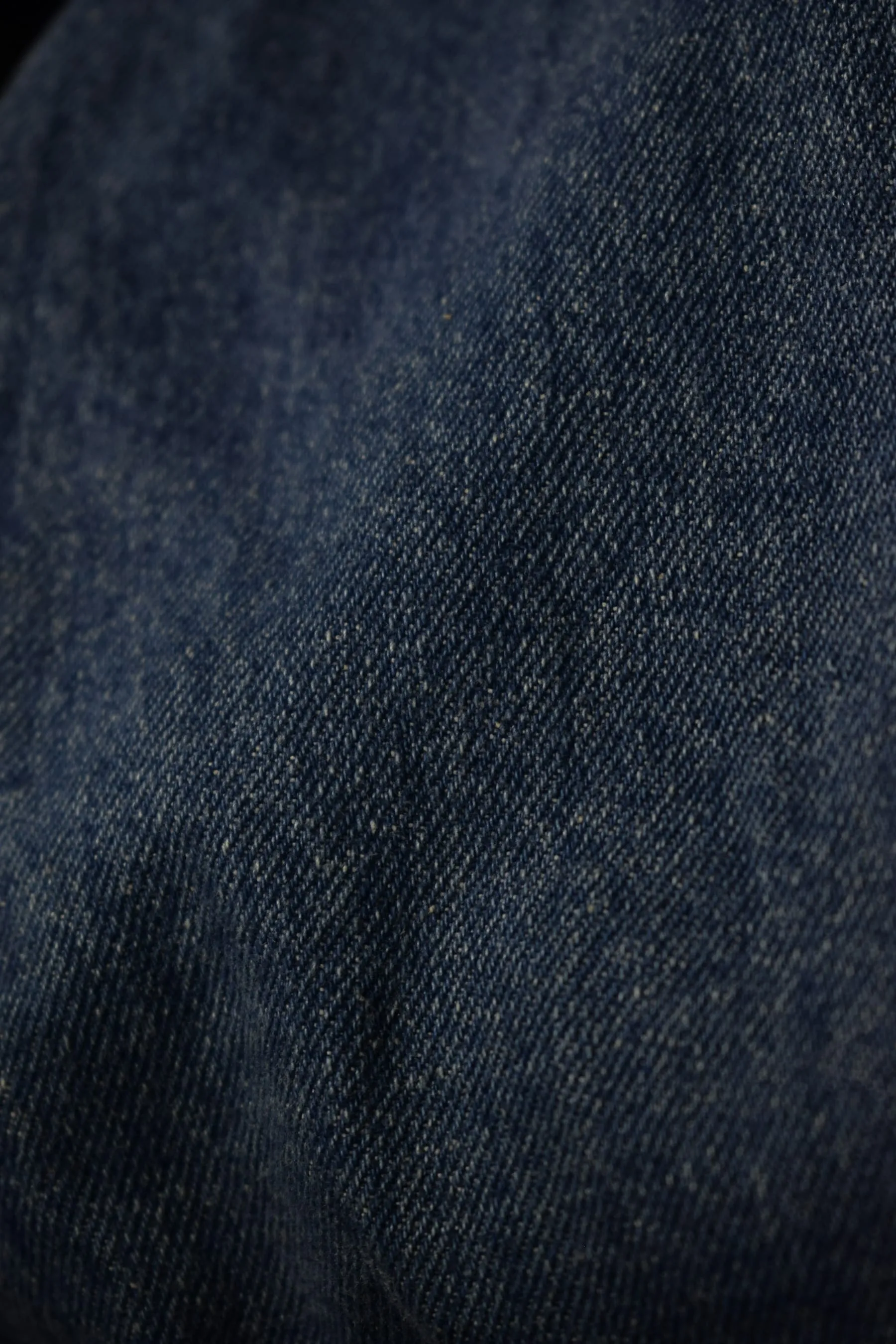
Rigid denim is usually 100% cotton and has no stretch beyond the give of the twill weave. It’s durable, softens with wear and is what classic five-pocket jeans were made from. Stretch denim has a small amount of elastane spun into the yarns so the jeans can stretch and recover as you move. Levi’s describes typical stretch denim as 1–3% elastane in the weft (the crosswise yarns), and Core Fabrics sees stretch denim for sewing in the 1–8% range.
| Rigid denim | Stretch denim | |
|---|---|---|
| Typical fiber | 100% cotton | Cotton with ~1–3% elastane; often a little polyester |
| Fit style | Straight, boyfriend, tapered, wide leg | Skinny, slim, jeggings |
| Feel when new | Stiff; breaks in over weeks | Soft and flexible from day one |
| Over a day of wear | Relaxes and molds to you | Relaxes too; recovery depends on quality |
| Sizing note | Heavier weights may need a size up | Higher spandex may need a size down |
A pattern drafted for one won’t fit right in the other. Closet Core’s Morgan jeans are designed for non-stretch and selvedge denim, and the pattern notes that heavier rigid denim has less give and may mean going up a size (Rick Rack Textiles listing). Closet Core’s Ginger jeans, a skinny style, are drafted for stretch denim and won’t close around you in rigid cloth.
How much spandex do stretch jeans need?
For the Ginger skinny jeans, designer Heather Lou says 2% Lycra is the ideal ratio, 1% also works with a bit less give, and fabrics with much more spandex (she has used up to 10%) meant sizing down a size or two. She suggests looking for denim with roughly 15–20% crosswise stretch (Closet Core: sourcing denim).
She also makes a point that surprises a lot of sewists: a little polyester in stretch denim is useful, because it helps keep the fabric from bagging out with wear. Core Fabrics’ guide says the same about poly in stretch denim.
How to test stretch and recovery on a swatch
- Mark 10 cm (4 inches) across the width of the denim (the crosswise grain, where stretch denim stretches).
- Stretch it along a ruler until it resists. If 10 cm reaches 11.5–12 cm, that’s 15–20% stretch.
- Hold it stretched for a few seconds, release, and look. Good denim snaps back to close to 10 cm. Denim that stays longer will bag at the knees and seat.
Which denim weight for skinny, straight or wide-leg jeans?
Weight changes how the leg hangs. Lighter denim drapes and clings; heavier denim holds its own shape.
| Jeans style | Denim type | Weight ballpark | Why |
|---|---|---|---|
| Skinny / jegging | Stretch, 1–2% spandex | ~7–10 oz | Light enough to hug the leg and move |
| Slim / stovepipe with stretch | Stretch, 1–2% spandex | ~8–12 oz | More heft so the straighter leg doesn’t cling |
| Straight / boyfriend / tapered | Rigid 100% cotton | ~10–14 oz | Classic structure that breaks in to your shape |
| Wide leg / high-waisted rigid | Rigid denim or rigid twill | ~10–13 oz | Holds a crease but still swings |
| Heavy workwear-style | Rigid, often selvedge | 14 oz and up | Durable and stiff; long break-in, harder to sew |
These are starting ranges drawn from pattern guidance, not hard rules. For Ginger, Closet Core suggests 7–12 oz, keeps the lightest, drapiest denim for the skinny view, and says anything over 12 oz may be too thick for such a close-fitting cut. The pattern listing also says denim under 8 oz isn’t recommended for the stovepipe view (Bolt & Spool listing). For Megan Nielsen’s rigid Dawn jeans (tapered, straight and wide-leg views), The Fabric Store’s review notes the pattern calls for bottomweight fabrics like denim, corduroy, linen or rigid twill, and their sample used a 12 oz rigid denim (The Fabric Store review).
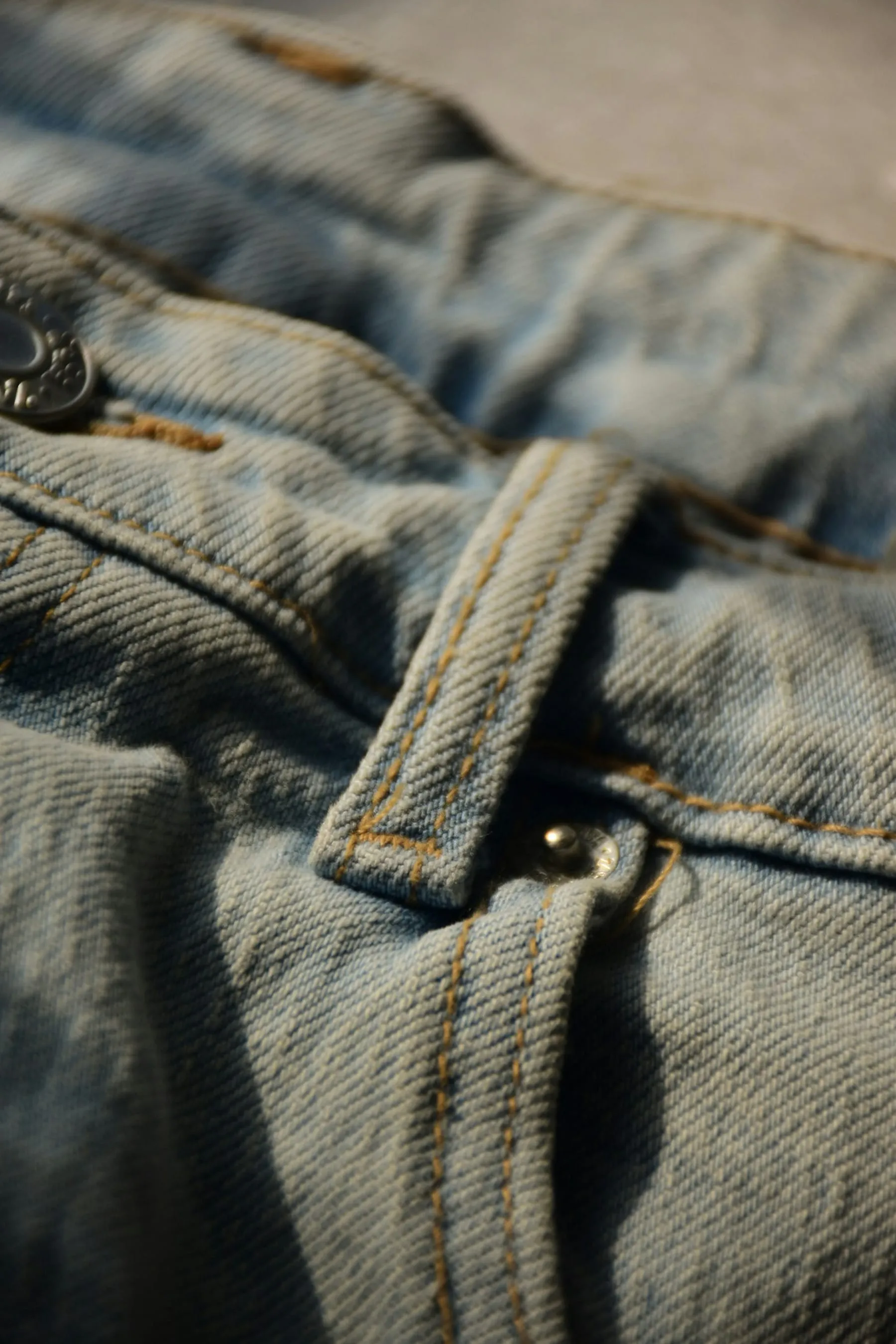
Selvedge denim: worth it for home sewing?
Selvedge (or selvage) denim is woven on traditional narrow shuttle looms, which leaves a clean, self-finished edge, often white with a colored stripe (Levi’s). Selvedge isn’t heavier by default, but it’s narrow: Core Fabrics puts it at about 30–35 inches wide, and Denimhunters says shuttle looms usually produce fabric around 30 inches (about 75 cm). That means you need more length for the same pair of jeans, and it usually costs more per yard.
To show the selvedge stripe at the outseam the way ready-to-wear does, your side seam has to be cut perfectly straight along the edge. Core Fabrics points out that this often doesn’t suit curvier hips without serious pattern changes. Selvedge is lovely for rigid straight-leg styles like Morgan; it’s an expensive and fiddly choice for a first pair or for skinny jeans.
Width and yardage
Check the width on the listing: yardage charts change a lot between 45-inch, 58–60-inch and narrow selvedge denim. Published charts give a feel for how much you need:
| Pattern | Width | Yardage |
|---|---|---|
| Closet Core Ginger (stretch) | 58” | 1½ yd (sizes 0–6) / 2–2¼ yd (sizes 8–20) |
| Closet Core Ginger (stretch) | 45” | 2½–3 yd |
| Megan Nielsen Dawn, tapered view (The Fabric Store’s sample) | 162 cm (~64”) | 1.6 m (~1¾ yd) |
Sources: Bolt & Spool’s Ginger listing and The Fabric Store’s Dawn review. For full size-by-size charts from Ginger, Morgan, Dawn and Thread Theory (including 30” selvedge), see how much fabric you need for jeans, or try our free fabric yardage calculator. On narrow selvedge denim, plan on substantially more length than a 58–60” chart shows, and check your pattern’s own chart.
Closet Core also suggests buying a little extra for a first pair so you can make a test version before cutting into the good stuff. If you’re in Southern California and want to feel denim weights in person, our guide to the best fabric stores in Los Angeles lists where to start.
Prewash first, especially rigid cotton
Cotton denim can shrink, and indigo can bleed. Wash and dry your yardage the way you’ll wash the finished jeans before you cut; our guide to prewashing fabric covers how. For a deeper look at cotton, polyester and elastane as fibers, see the fabric fiber guide.
Match the denim to the pattern, not the other way round. A skinny pattern in rigid denim won’t close; a rigid pattern in stretchy denim will bag.
Sewing denim on a home machine: the short version
Denim’s thick seam crossings (yokes, flat-felled inseams, waistbands, hems) are where home machines struggle. Needle maker Schmetz recommends its Jeans needle, which has a reinforced blade and a medium ball point, for denim, twill and canvas (Schmetz Jeans needle). In its jeans sewing guide, Schmetz suggests sizes in the 90 to 110 range (90/14 to 110/18) depending on thickness, and notes a universal needle in 90–100 can also work if you prefer it after a scrap test (Schmetz: sewing jeans).
Start with the smallest size that sews cleanly through your thickest seam. Lighter stretch denim often does fine at 90/14; dense rigid denim at the crossings may need 100/16.
For thread, stitch length, tension, hammering bulky seams, hump jumpers and topstitching, see our step-by-step guide to sewing denim on a home sewing machine.
Common questions
What is the best fabric for sewing jeans?
Cotton denim matched to the cut. Use stretch denim of about 7–12 oz with 1–2% spandex for skinny and close-fitting jeans, and rigid 100% cotton denim of about 10–14 oz for straight, boyfriend and wide-leg jeans. Follow your pattern’s fabric note first.
What weight denim is best for jeans?
For home-sewn jeans, around 11–12 oz is a good all-purpose weight for rigid denim. Stretch skinny jeans usually sew best in lighter 7–12 oz denim. Over about 18 oz is generally too heavy and thick to be comfortable.
How much spandex should stretch denim have?
About 1–2% is the sweet spot for most stretch jeans patterns, with 2% often called ideal. Denim with much more spandex can work, but you may need to size down because the fabric stretches more than the pattern expects.
Can I use stretch denim for a rigid jeans pattern?
You can, but the fit will change. Jeans drafted for rigid denim have more built-in ease, so stretch denim will usually feel looser and may bag. Baste a fitting first and be ready to size down or take in the side seams.
Is selvedge denim good for sewing jeans?
It’s beautiful and durable, but it’s narrow (about 30–35 inches), so you need more yardage, and showing the selvedge stripe requires a straight outseam. It suits rigid straight-leg patterns better than curvy or skinny ones.
What needle should I use for denim?
A jeans/denim needle, starting around 90/14 and moving to 100/16 for thick seam crossings. Test on scrap layers first, and check that your machine takes standard household needles (system 130/705 H).
Sources
- Closet Core Patterns: Sourcing denim for the Ginger jeans (2% Lycra, 15–20% stretch, 7–12 oz, sizing and polyester notes)
- Bolt & Spool: Closet Core Ginger jeans listing (fabric note, yardage)
- Rick Rack Textiles: Closet Core Morgan jeans listing (non-stretch and selvedge denim, sizing note)
- The Fabric Store: Pattern review: Dawn jeans (bottomweight fabrics, 12 oz rigid denim, 1.6 m)
- Core Fabrics: All about denim (sewing-fabric weight scale, stretch %, selvedge width)
- Levi’s: Complete guide to denim terminology (weight scale, 1–3% elastane, selvedge)
- Heddels: Understanding raw denim weights (oz per square yard)
- Denimhunters: What is denim weight? (gsm conversion, no global standard, shuttle-loom width)
- Schmetz: Jeans needle and Sewing jeans (needle type and sizes)
Free printable · The newsletter
Never guess yardage again.
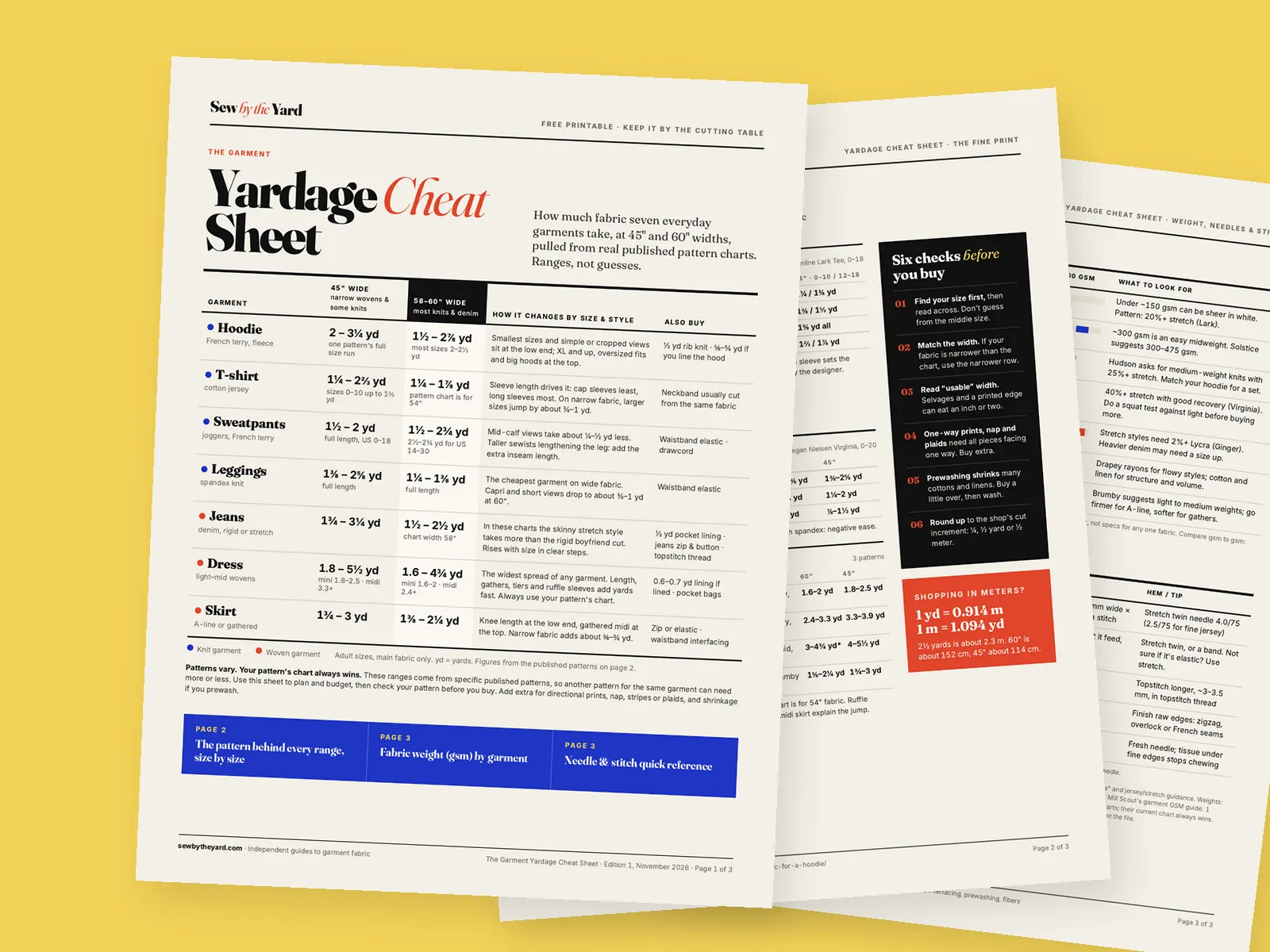
Join the Sew by the Yard newsletter and get The Garment Yardage Cheat Sheet: fabric amounts for seven garments at 45" and 60", a fabric-weight guide and a needle chart, on three printable pages.