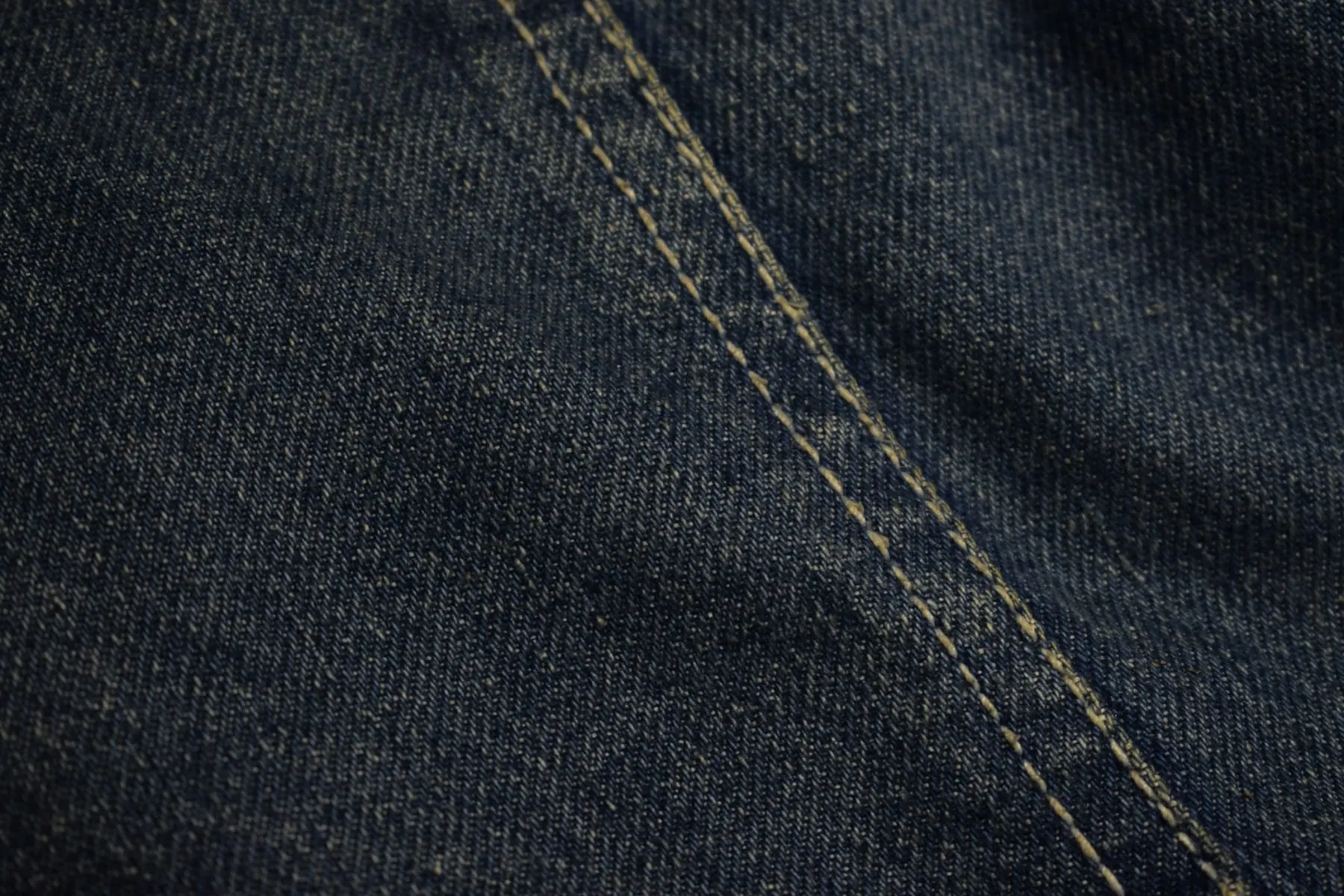
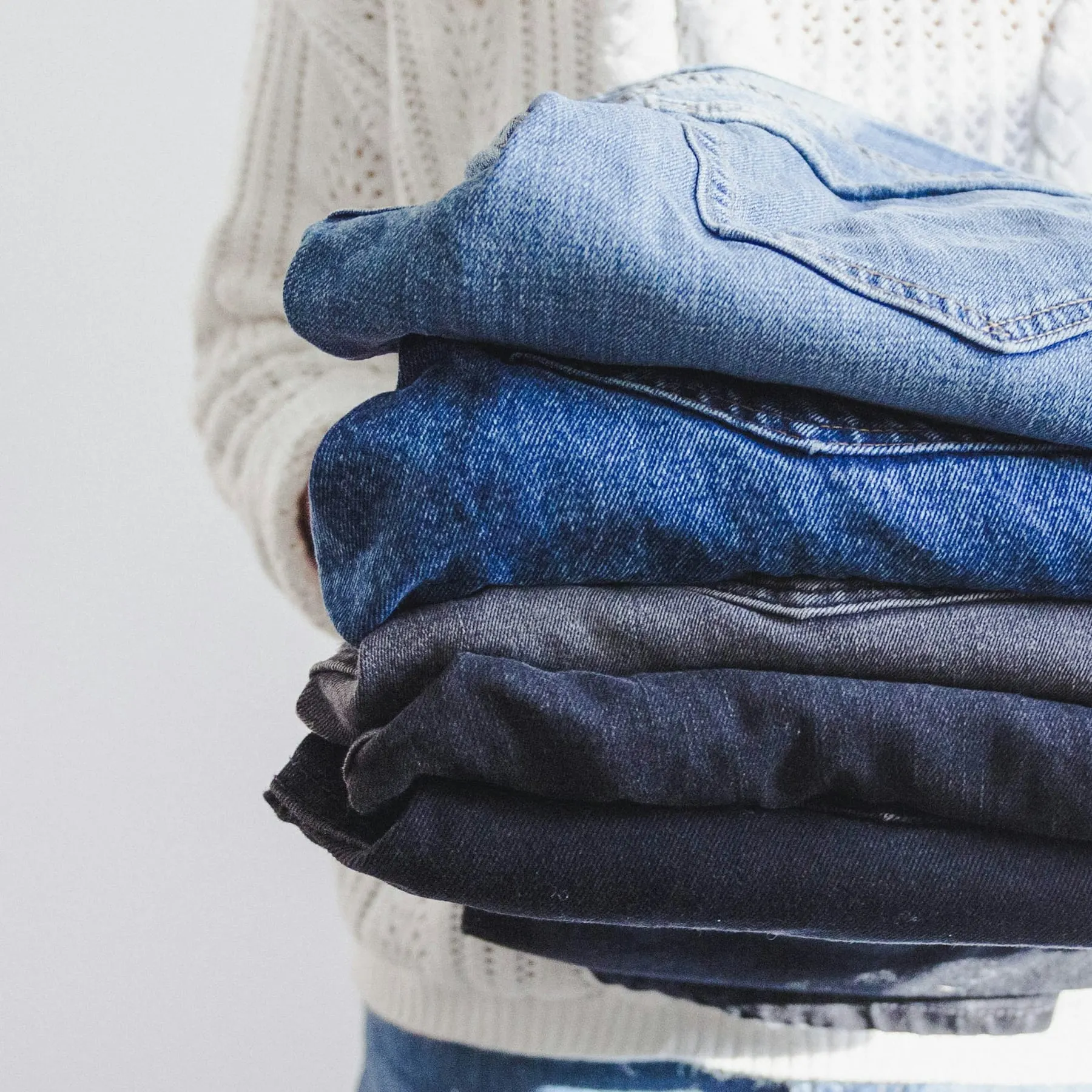
How Much Fabric Do You Need for Jeans? Width, Size, and Layout Guide
Most adult jeans take 1½–2½ yards of 58–60" denim, 2½–3¼ yd of 45" and 3¼–3¾ yd of 30" selvedge. Charts from Ginger, Morgan, Dawn and Thread Theory patterns.
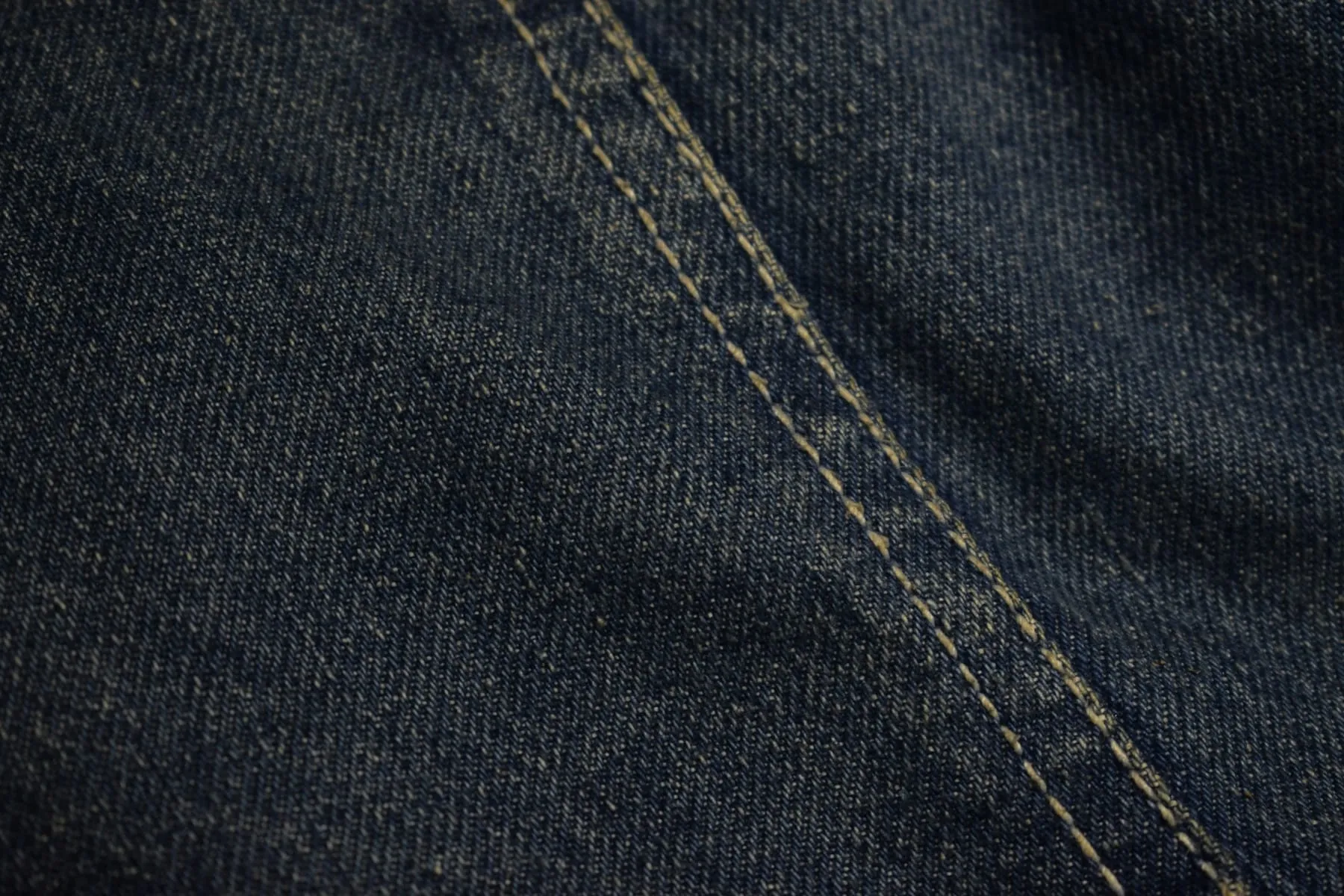
Most adult jeans take about 1½–2½ yards (1.4–2.3 m) of 58–60 inch denim, depending on size and leg shape. On 45 inch fabric, published charts run about 2–3¼ yards, and on narrow 30 inch selvedge denim Closet Core’s Morgan chart asks for 3¼–3¾ yards. Add about ½ yard of cotton for pocket linings, and treat your own pattern’s chart as the final number. For how jeans yardage sits next to other garments, see the 2026 Sew by the Yard Yardage Index.
How much fabric do jeans take, at a glance?
Smallest to largest size group in each pattern’s own published chart. Main fabric only; pocket lining is extra.
| Pattern (style) | 58–60” denim | 45” fabric | Notes |
|---|---|---|---|
| Closet Core Ginger (stretch, skinny or stovepipe), sizes 0–20 | 1½–2½ yd | 2½–3¼ yd | Same chart for both views |
| Closet Core Ginger, curvy sizes 14–32 | 2½ yd (all sizes) | 2½–3 yd | Separate block and chart |
| Closet Core Morgan (rigid, tapered boyfriend), sizes 0–20 | 1½–2¼ yd | 1¾–2¾ yd | Also lists 30” selvedge: 3¼–3¾ yd |
| Megan Nielsen Dawn A (rigid, tapered), sizes 0–20 | 1¾–1⅞ yd | 2⅛–2½ yd | 1.6–1.7 m / 1.9–2.3 m |
| Megan Nielsen Dawn B (straight) | 1¾–2 yd | 2⅛–2½ yd | 1.6–1.8 m / 2–2.3 m |
| Megan Nielsen Dawn C (wide leg) | 2⅛–2⅝ yd | 2¾ yd | Widest legs, most fabric |
| Thread Theory Jutland (men’s straight, waist 30–45”) | 2.7 yd (2.5 m) | 3.0 yd (2.8 m) | One figure for all sizes |
| Thread Theory Jedediah (men’s slim, waist 30–40”) | 2.7 yd (2.4 m) | 3.0 yd (2.7 m) | Chino-style, sewn in denim or twill |
Sources for every row are linked in the detailed charts below.
Jeans yardage charts by size (from published patterns)
Every figure below is copied from the pattern’s published fabric requirements. Follow the links to check them. Sizes are each designer’s own size names, which don’t line up exactly from brand to brand.
Closet Core Ginger Jeans (stretch denim)
From Closet Core’s Ginger pattern page. The same yardage covers View A (low-rise stovepipe) and View B (high-rise skinny). Closet Core calls for stretch denim with at least 2% Lycra.
Sizes 0–20
| Fabric width | 0–6 | 8–12 | 14–16 | 18 | 20 |
|---|---|---|---|---|---|
| 58” (1.5 m) | 1½ yd (1.4 m) | 2 yd (1.8 m) | 2¼ yd (2.1 m) | 2¼ yd (2.1 m) | 2½ yd (2.3 m) |
| 45” (1.14 m) | 2½ yd (2.3 m) | 2¾ yd (2.5 m) | 3 yd (2.75 m) | 3¼ yd (3 m) | 3¼ yd (3 m) |
Sizes 14–32 (curvy block)
| Fabric width | 14–16 | 18–24 | 26–32 |
|---|---|---|---|
| 58” (1.5 m) | 2½ yd (2.25 m) | 2½ yd (2.25 m) | 2½ yd (2.25 m) |
| 45” (1.14 m) | 2½ yd (2.3 m) | 2¾ yd (2.5 m) | 3 yd (2.75 m) |
Both ranges add ½ yd (0.5 m) of pocket lining and ¼ yd of fusible interfacing.
Closet Core Morgan Jeans (rigid denim, including selvedge)
From Closet Core’s Morgan pattern page and the Morgan size and fabric chart (PDF). Morgan is designed for non-stretch denim, and its chart is one of the few that prints a row for 30” selvedge.
| Fabric width | 0–6 | 8–14 | 16 | 18–20 |
|---|---|---|---|---|
| 58” (1.5 m) | 1½ yd (1.4 m) | 1¾ yd (1.6 m) | 2¼ yd (2 m) | 2¼ yd (2 m) |
| 45” (1.15 m) | 1¾ yd (1.6 m) | 2 yd (1.8 m) | 2½ yd (2.3 m) | 2¾ yd (2.5 m) |
| 30” (0.8 m) selvedge | 3¼ yd (3 m) | 3½ yd (3.25 m) | 3¾ yd (3.5 m) | 3¾ yd (3.5 m) |
Lining for pockets and waistband: ½ yd in every size. The product page groups sizes 16–20 together at 45” (2¾ yd); the PDF chart splits out size 16 at 2½ yd.
Megan Nielsen Dawn Jeans (rigid, four leg shapes)
From The Fold Line’s Dawn listing (sizes 0–20) and Threadloop’s Dawn listing (curve sizes 14–30). Dawn calls for bottomweight fabrics such as rigid denim, twill, linen or corduroy. Megan Nielsen’s own page notes the requirements already include a 5% shrinkage allowance.
| View | Sizes 0–20, 60” | Sizes 0–20, 45” | Sizes 14–30, 60” | Sizes 14–30, 45” |
|---|---|---|---|---|
| A, tapered | 1.6–1.7 m (1¾–1⅞ yd) | 1.9–2.3 m (2⅛–2½ yd) | 1.6–2.6 m | 2.2–2.6 m |
| B, straight | 1.6–1.8 m (1¾–2 yd) | 2–2.3 m (2⅛–2½ yd) | 1.7–2.6 m | 2.2–2.6 m |
| C, wide leg | 2–2.4 m (2⅛–2⅝ yd) | 2.5 m (2¾ yd) | 2.3–2.6 m | 2.5–3.5 m |
| D, shorts | 0.9–1.2 m (1–1¼ yd) | 1.2 m (1¼ yd) | 1–1.4 m | 1.2–1.5 m |
Pockets come from fabric scraps. Extra fabric may be needed to match a patterned fabric.
Thread Theory Jutland and Jedediah (men’s)
From The Fold Line’s listings for Jutland and Jedediah. Thread Theory gives one figure for every size.
| Pattern | 60” (150 cm) | 45” (115 cm) | Pocket lining |
|---|---|---|---|
| Jutland, Variation 1 (straight jeans/pants) | 2.5 m (2.7 yd) | 2.8 m (3.0 yd) | 1.4 m (1.5 yd) |
| Jutland, Variation 2 (cargo/outdoor) | 2.6 m (2.8 yd) | 3.2 m (3.5 yd) | 1.4 m (1.5 yd) |
| Jedediah, Variation 1 (full length) | 2.4 m (2.7 yd) | 2.7 m (3.0 yd) | 0.4 m (½ yd) |
| Jedediah, Variation 2 (shorts) | 1.7 m (1.9 yd) | 1.7 m (1.9 yd) | 0.4 m (½ yd) |
Jutland is pitched for everything from denim jeans to hiking pants; Jedediah is a slim, chino-style pant that Thread Theory says wears well in denim. Both use one chart for all sizes, so smaller sizes will often have leftover fabric.
What the charts tell you
On 58–60” denim, most adult women’s sizes in these charts fall between 1½ and 2½ yards, with wide legs and larger sizes at the top. Men’s patterns, cut longer and with one chart for all sizes, sit around 2¾ yards. On 45” fabric, add roughly half a yard to a yard. On 30” selvedge, Morgan’s chart roughly doubles the 58” figure in the smallest sizes (3¼ yd versus 1½ yd).
No pattern yet and just want a ballpark? 2½ yards of 58–60” denim covers every women’s size 0–20 row on 58–60” fabric above except Dawn’s wide leg (up to 2⅝ yd), and 3 yards covers the men’s charts. Check your pattern before you cut.
A pair of jeans that fits on 1½ yards of 58” denim can need 3¼ yards of 30” selvedge. Check the width before you check out.
What changes how much fabric jeans need?
1. Fabric width (the big one)
Jeans legs are long. On wide denim, a front and back leg can sit side by side across the fabric; on narrow fabric they have to be placed one after another down the length. That’s why the jump from 58” to 45” in Ginger’s chart is a full yard in the smallest sizes (1½ to 2½ yd).
Common denim widths:
- 58–60”: most stretch and many rigid denims sold by the yard.
- About 45”: some rigid denims, bottomweight linens and quilting-width twills.
- About 30–35”: selvedge denim from narrow shuttle looms. Our best fabric for jeans guide explains what selvedge is and why it’s narrow.
If your fabric is narrower than any width on your pattern’s chart, lay the pieces out on paper (see the layout method below) rather than guessing.
2. Size
Every chart above climbs with size, but not smoothly. Ginger at 58” stays at 2 yd through sizes 8–12, then steps to 2¼. Morgan jumps half a yard between sizes 14 and 16. Read your exact size, not the middle of the range.
3. Leg shape and length
Wider legs need more fabric. In Dawn’s chart, the wide-leg view needs about 2⅛–2⅝ yd on 60” fabric versus 1¾–1⅞ yd for the tapered view. Tall inseams, flares and wide hems all push you toward the top of a range; cropped and shorts views need far less (Dawn’s shorts take 1–1¼ yd).
4. Stretch, shrinkage and direction
- Prewash shrinkage: cotton denim can shrink in the first wash. Megan Nielsen builds a 5% allowance into Dawn’s chart; other designers may not, so buy a little extra for rigid cotton. Our prewashing guide has a quick shrinkage test, and how to measure stretch and recovery shows how to check stretch denim against Ginger’s requirement.
- One direction: denim has a twill line and a face side. Cut every piece with the grain running the same way and the same side up, especially on washed or faded denim where shade changes with direction.
- Stretch direction: on stretch denim, the stretch usually runs across the width. Legs must be cut so the stretch goes around the body, which limits how you can turn pieces to save fabric.
How do you work out your exact jeans yardage?
- Choose your size from the pattern’s body chart. For jeans, hip is usually the deciding measurement.
- Find your fabric width on the listing. Use the matching row on the chart, or the next narrower one.
- Read the main-fabric number where your size, width and view meet.
- Add the extras: pocket lining (usually ½ yd of quilting cotton or pocketing), about ¼ yd of fusible interfacing, and a buffer for prewash shrinkage on rigid cotton.
- Round up to the nearest quarter or half yard, depending on how the shop sells.
For a size-by-size estimate with the extras added, use our free fabric yardage calculator, or print the fabric yardage chart (PDF) to take to the store.
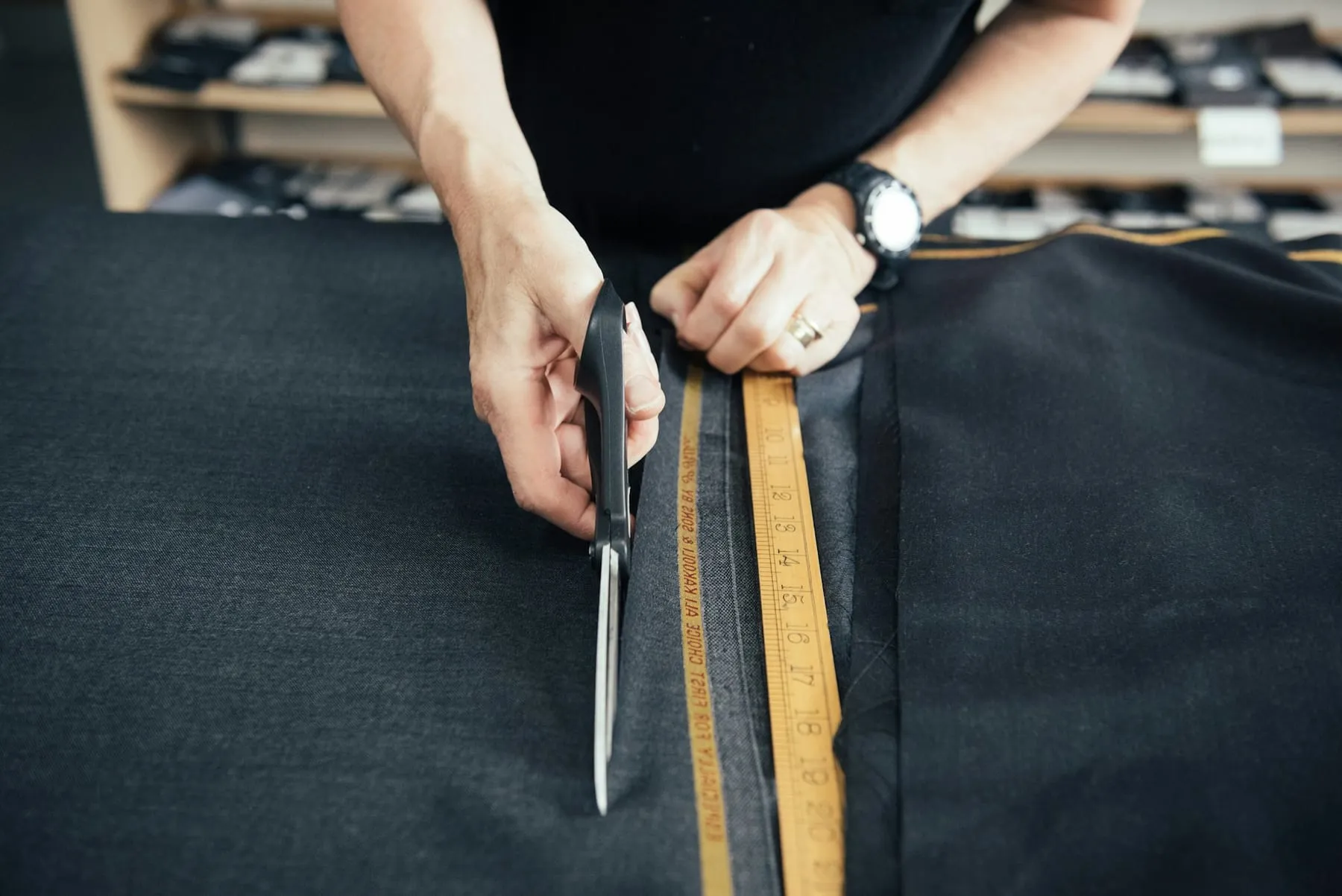
The paper layout method (for selvedge or odd widths)
When your denim is narrower or wider than every row on the chart, measure it yourself:
- Cut out your pattern pieces in your size, including any length changes.
- On the floor or a big table, mark two lines as far apart as your fabric is wide (for example, 30” for selvedge), or half that if you’ll cut on the fold.
- Lay out every piece the way it must be cut: grain lines parallel to the edges, all pieces facing the same direction, and pairs (two fronts, two backs) accounted for.
- Measure from the first piece to the last. Add a few inches for straightening the cut end and for shrinkage.
For selvedge, place the leg outseams along the selvedge edges if you want the stripe to show inside the side seam. That requires a straight outseam, so it suits straight-leg patterns like Morgan better than curvy or skinny cuts.
Worked examples: what to buy for one pair
Stretch skinny jeans. Closet Core Ginger View B, size 10, on 58” stretch denim:
- Main fabric: 2 yd (sizes 8–12, 58”)
- Pocket lining: ½ yd of quilting cotton
- Interfacing: ¼ yd
- Buffer for prewashing: round the denim up to 2¼ yd
Rigid selvedge jeans. Closet Core Morgan, size 10, on 30” selvedge:
- Main fabric: 3½ yd (sizes 8–14, 30”), versus 1¾ yd if the same denim came in 58”
- Pocket and waistband lining: ½ yd
- Interfacing: ¼ yd
Men’s straight jeans. Thread Theory Jutland Variation 1 on 60” denim: 2.7 yd of denim plus 1.5 yd of pocket lining (Thread Theory’s figure for that view).
What else do you need besides denim?
Most jeans patterns list a similar shopping list alongside the main fabric:
- Pocket lining: ½ yd of a medium-weight woven like quilting cotton (Closet Core, Thread Theory Jedediah), up to 1½ yd for Jutland’s pocket set. Dawn uses scraps.
- Interfacing: about ¼ yd of fusible interfacing for the waistband and fly (Closet Core). Our interfacing basics guide covers choosing a weight.
- Fly: a denim zipper (Ginger lists 6–8” depending on view and size range) or jeans buttons for a button fly (Morgan: 4–6 by size; Dawn: 4).
- Hardware and thread: a jeans button, optional rivets, topstitching thread and denim needles.
For needle sizes, thread, seam bulk and topstitching, see our full guide to sewing denim on a home sewing machine. Our best fabric for jeans guide covers denim weight and rigid versus stretch.
Common questions
How many yards of fabric do I need for jeans?
Most adult jeans need about 1½–2½ yards of 58–60” denim. Closet Core’s Ginger chart runs 1½ yd (sizes 0–6) to 2½ yd (size 20 and the 14–32 range), and Megan Nielsen’s Dawn runs 1¾–2⅝ yd depending on leg shape. Men’s patterns like Thread Theory’s Jutland and Jedediah list about 2.7 yd. Your pattern’s chart is the final word.
How many meters of fabric do I need for jeans?
On 150 cm (58–60”) fabric, published charts run about 1.4–2.3 m for Ginger sizes 0–20, 1.6–2.4 m for Dawn sizes 0–20, and 2.4–2.6 m for Thread Theory’s men’s patterns. On 115 cm (45”) fabric, the same charts run about 1.6–3.2 m.
How much selvedge denim do I need for jeans?
Much more than wide denim, because selvedge is usually only about 30–35” wide. Closet Core’s Morgan chart lists 3¼ yd (sizes 0–6), 3½ yd (8–14) and 3¾ yd (16–20) of 30” selvedge, about twice its 58” figures. If your pattern has no selvedge row, use the paper layout method above.
Can I make jeans with 2 yards of fabric?
Often, on 58–60” denim in small to mid sizes. Ginger sizes 0–12, Morgan sizes 0–14, and Dawn’s tapered and straight views in sizes 0–20 all fit within 2 yards on wide fabric. Larger sizes, wide legs, men’s patterns, 45” fabric and selvedge usually need more.
How much fabric for wide-leg jeans?
More than tapered or skinny styles. Megan Nielsen’s Dawn View C (wide leg) needs 2–2.4 m (2⅛–2⅝ yd) of 60” fabric or 2.5 m (2¾ yd) of 45” fabric in sizes 0–20, and up to 3.5 m on 45” in the curve range.
How much fabric do I need for jean shorts?
About 1–1¼ yards. Dawn’s shorts view lists 0.9–1.2 m (1–1¼ yd) on 60” fabric and 1.2 m (1¼ yd) on 45”, and Thread Theory’s knee-length Jedediah shorts list 1.7 m (1.9 yd) for all men’s sizes.
Do I need extra fabric for pocket linings?
Usually. Closet Core lists ½ yd of medium-weight woven lining for both Ginger and Morgan, and Thread Theory lists ½ yd for Jedediah and 1½ yd for Jutland. Quilting cotton is a common choice. Megan Nielsen’s Dawn uses fabric scraps for pockets.
What fabric should I use for jeans?
Stretch denim with about 2% spandex for skinny styles like Ginger, and rigid 100% cotton denim for straight, boyfriend and wide-leg styles like Morgan and Dawn. Our best fabric for jeans guide explains denim weight, stretch and selvedge, and our fabric fiber guide covers cotton and elastane.
Sources
- Closet Core Patterns: Ginger jeans pattern (yardage for sizes 0–20 and 14–32 at 45” and 58”, lining, interfacing, zipper lengths, 2% Lycra)
- Closet Core Patterns: Morgan jeans pattern and Morgan size and fabric chart (PDF) (45”, 58” and 30” yardage, lining, buttons, sizing notes)
- The Fold Line: Megan Nielsen Dawn jeans (yardage by view, sizes 0–20; notions)
- Threadloop: Dawn jeans by Megan Nielsen Patterns (curve-range yardage, sizes 14–30)
- Megan Nielsen Patterns: Dawn jeans (5% shrinkage allowance note)
- The Fold Line: Thread Theory Jutland pants and Thread Theory Jedediah pants (men’s yardage and pocket lining)
Free printable · The newsletter
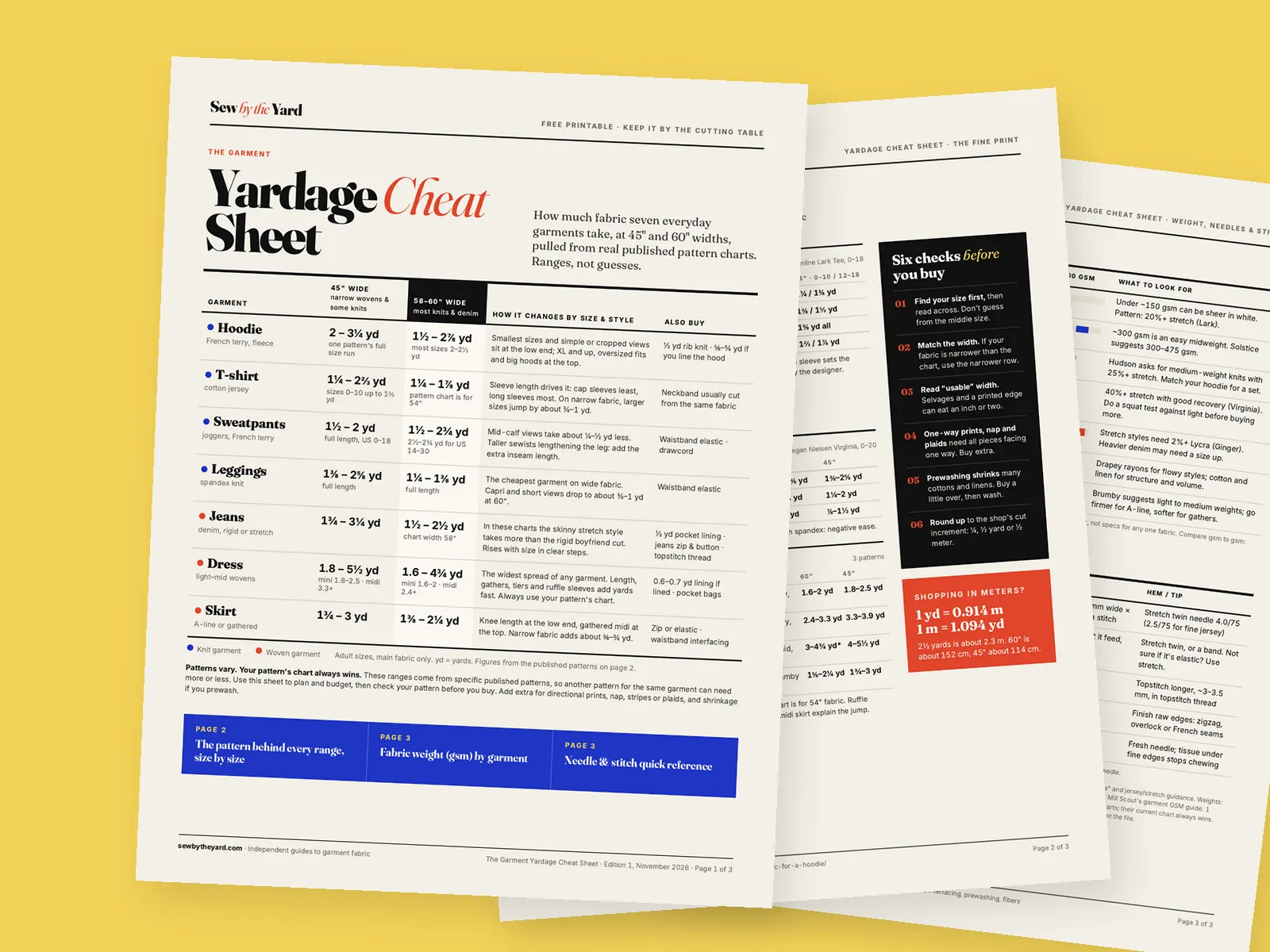
Never guess yardage again.
Join the Sew by the Yard newsletter and get The Garment Yardage Cheat Sheet: fabric amounts for seven garments at 45" and 60", a fabric-weight guide and a needle chart, on three printable pages.