How Much Ribbing for a Hoodie?
Most adult hoodies need about ½ yard of rib knit. How much to buy, and how long to cut cuffs and the hem band, with ratios from published sewing guides.
For most adult hoodies, buy about ½ yard of rib knit. That is enough for two cuffs and a hem band on typical patterns: Helen’s Closet calls for 0.4–0.5 yard of ribbing for every view of the Solstice Hoodie, and Sinclair’s Uno lists 7 inches of ribbing for smaller sizes and 12–14 inches for larger ones when the bottom band and cuffs are rib. Cut each piece shorter than the opening it goes on, with the greatest stretch running around the wrist or body, then stretch only the band as you sew.
Rib knit is the trim, not the body fabric. The hoodie itself is usually French terry or sweatshirt fleece; the rib is what keeps cuffs and the hem from stretching out. Our guides to best fabric for hoodies and how much fabric for a hoodie cover the main yardage, and our printable fabric yardage chart and fabric yardage calculator give it by size. This page is the ribbing chart.
How much ribbing should you buy?
Use your pattern’s ribbing line first. If it does not have one, these published numbers are a realistic shopping range.
| Pattern | Ribbing to buy | Width assumed | What it covers |
|---|---|---|---|
| Helen’s Closet Solstice Hoodie | 0.4 yd (sizes 0–16) to 0.5 yd (sizes 18–34) | 37” or 45” rib; the yardage is the same at both widths | Cuffs and hem band, all views (The Fold Line) |
| Sinclair Uno hoodie | 7 in (18 cm) for US 0–10; 12–14 in (30–36 cm) for US 12–30 | From the pattern’s rib line as listed in our hoodie yardage chart | Bottom band and cuffs, when you use rib for both |
| Grainline Linden sweatshirt (no hood) | 0.6 m (about ⅝ yd) | 36” rib, Threadloop listing | Neckband, cuffs and hem on the sweatshirt version |
For most adult hoodies, ½ yard is the simple number to remember, unless the pattern also wants a wide waistband or a rib neckband on top of the cuffs and hem. Rib is usually sold separately from the body fabric, often in a different width (sometimes about 36–45 inches rather than 60). Check the listing width before you assume a half yard will be a long enough cut.
If you are sewing a matching crewneck, Linden’s figure is a useful reminder that a neckband adds a little more rib, not another half yard.
How long should you cut cuffs and the hem band?
When the pattern includes cuff and waistband pieces, use those. When you are drafting a band, or the pattern only gives a finished opening, the usual method is:
Band cut length = opening × ratio + two seam allowances
Band cut height = (finished height × 2) + two seam allowances
Measure the opening on the seamline, not the cut edge. The band is folded in half, so the cut height is twice the finished height, plus allowances. The greatest stretch of the rib runs along the length of the strip, around the wrist or body.
Published starting ratios:
| Band | Cut length as a share of the opening | Source |
|---|---|---|
| Rib sleeve cuff | 75–80% of the sleeve opening | Ourlette, How to sew a cuff |
| Self-fabric jersey cuff | about 85% | Ourlette |
| French terry or fleece cuff (self-fabric) | about 90% | Ourlette |
| Sweatshirt or hoodie hem band | 85–90% of the hem | Ourlette, Sewing with rib knit |
| Crew neckband | 80–85% of the neckline (70–80% for very stretchy rib) | Ourlette; our T-shirt neckband guide also uses about 85% for jersey and 70–80% for stretchy rib |
| Knit waistband, cuffs or neckband (general rule) | around 80%, adjusted toward 70% or 90% if the rib is very stretchy or fairly firm | BERNINA Blog, Cuffs and bands |
Ourlette’s cuff example: for a 24 cm (9½ in) sleeve opening, a rib cuff is cut 18–19 cm (7–7½ in) long before you add two seam allowances. For height, a 6 cm (2⅜ in) finished cuff with 1 cm (⅜ in) allowances is cut 14 cm (5½ in) high.
Ourlette’s rib-knit guide uses the lower end of each range for a very stretchy 2×2 rib and the upper end for a firmer 1×1 cotton rib. BERNINA describes the same idea: start around 80% of the opening, then move toward 90% or 70% if your rib is less stretchy or more stretchy than usual.
A worked hoodie example
Say the sleeve opening measures 10 inches on the seamline, the hem measures 40 inches, and you are using a standard ⅜-inch seam allowance with a rib cuff and a 3-inch finished hem band.
- Each rib cuff at 80%: 10 × 0.80 = 8 inches, plus ¾ inch for two allowances, so 8¾ inches long. For a 3-inch finished cuff, cut 6¾ inches high (3 × 2 + ¾). Cut two.
- Hem band at 85%: 40 × 0.85 = 34 inches, plus ¾ inch, so 34¾ inches long by 6¾ inches high.
Those lengths are a starting point. If your rib is very stretchy and snaps back hard, you can try the 75% cuff ratio. If it is firm, start closer to 80–85% for the cuff and 90% for the hem. Sew a test loop, or baste one cuff, before you cut the last of a short piece of rib.
On 45-inch-wide rib, a 6¾-inch-high strip is long enough to cut the hem band and both cuffs from one pass if you plan the layout, which is why a half yard (18 inches) is usually plenty of length off the bolt. On narrower rib, you may need that full half yard just to fit the hem band along the width.
How to sew the bands on
The construction is the same idea as a T-shirt neckband: close the band into a loop, fold it, mark it, and stretch only the band as you sew. The full technique, including how to sew a small cuff in the round, when to pin in half instead of quarters, and how to fix a twisted or baggy cuff, is in how to cut and sew hoodie rib cuffs and hem bands.
- Sew the short ends of the band into a loop. Press the seam open or to one side, then fold the band in half lengthwise, wrong sides together, and press.
- Divide the band and the garment opening into quarters and pin or clip the marks together.
- Sew with a stretch stitch or a narrow zigzag, stretching only the band between pins, not the sleeve or the body.
- Steam the seam when you are done; don’t pull it as you press.
The T-shirt neckband guide shows the same quarter-pin method on a crew neck. Needle and stitch settings for knits are in how to sew knits without a serger. If you don’t have rib, Helen’s Closet notes that a stable but stretchy knit such as cotton-spandex can stand in for Solstice ribbing (introducing Evergreen and Solstice). Cut self-fabric using the higher ratios in the table, not the shortest rib ratios.

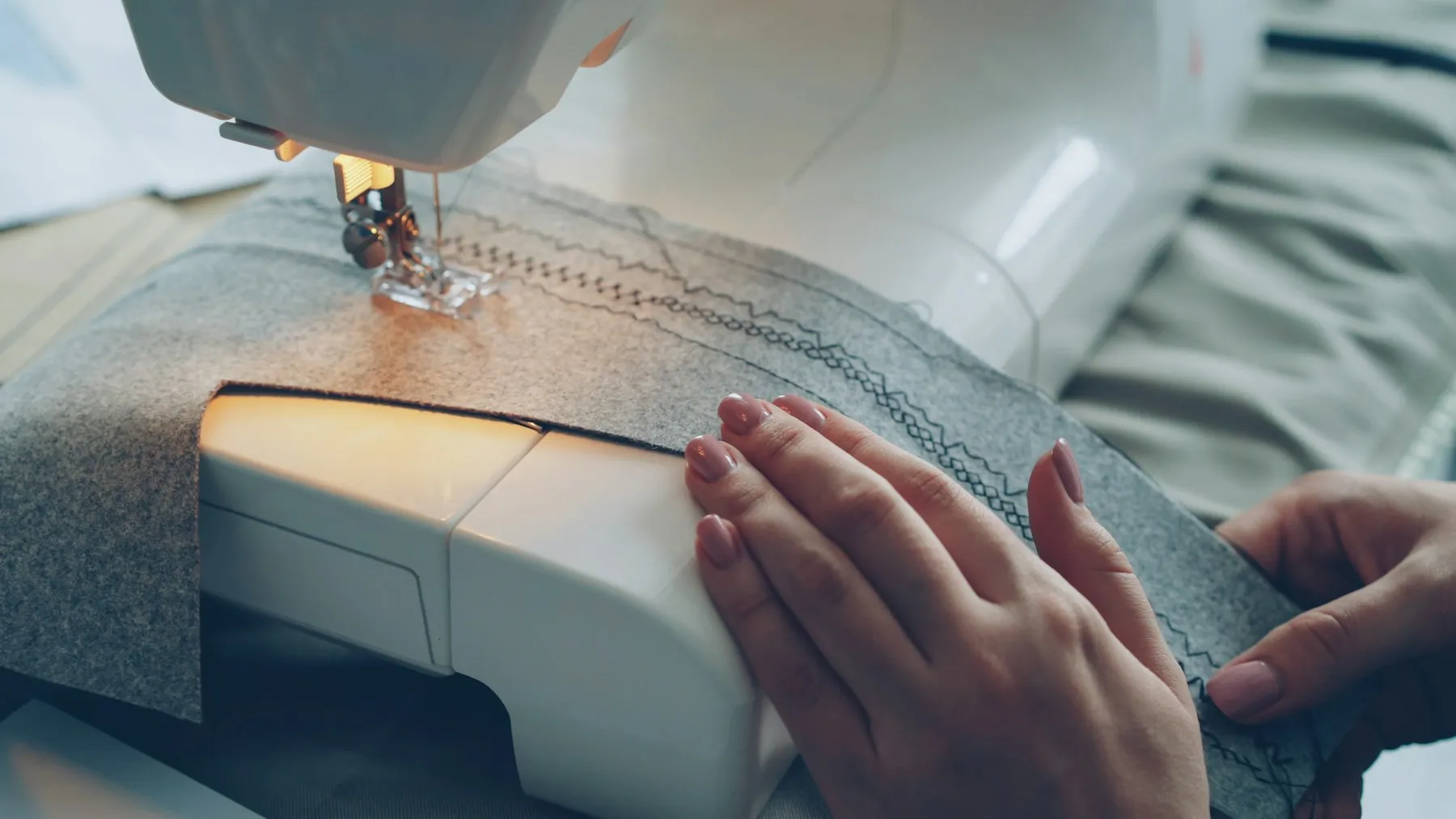
Buy about half a yard of rib. Cut it shorter than the opening, and stretch only the band.
Common questions
How much ribbing do I need for a hoodie?
About ½ yard for most adult patterns. Helen’s Closet lists 0.4–0.5 yard for the Solstice, and Sinclair lists 7 to 14 inches for the Uno when the cuffs and bottom band are rib. Buy a little more if you also need a rib neckband or a very wide waistband, or if the rib is sold narrower than the pattern assumes.
How do you calculate ribbing length for cuffs?
Measure the sleeve opening on the seamline, multiply by 0.75 to 0.80 for rib (Ourlette), and add two seam allowances. Cut the height at twice the finished cuff height plus two allowances, with the stretch running along the length.
What percentage should a hoodie waistband be?
Ourlette’s starting range for a sweatshirt hem band is 85–90% of the hem opening. BERNINA’s general rule for waistbands, cuffs and neckbands is about 80%, moved up or down for firmer or stretchier rib. Use the pattern piece when you have one.
Can I use leftover body fabric instead of rib?
You can if the leftover knit has enough stretch and recovery. Ourlette treats self-fabric jersey at about 85% of the opening and French terry or fleece at about 90%, which is longer than a rib cuff. If the self-fabric stays stretched when you let go, the cuff will bag.
Which way do you cut ribbing?
Cut the strip so the ribs run across its short height and the greatest stretch runs along its length, around the wrist or body. Ourlette notes that ribs run with the grain, and for bands the length of the band runs across the ribs.
Sources
- Helen’s Closet Solstice Hoodie, via The Fold Line (ribbing yardage 0.4–0.5 yd)
- Sinclair Uno hoodie pattern page, as compiled in our hoodie yardage chart (7–14 in of rib)
- Grainline Linden ribbing via the Threadloop listing cited in that same chart
- Ourlette: How to sew a cuff (cuff ratios, worked 24 cm example, hand-clearance check)
- Ourlette: Sewing with rib knit (band ratios, including sweatshirt hem bands)
- BERNINA Blog: Tips for sewing with knits: cuffs and bands (about 80% as a general starting point)
- Helen’s Closet: Introducing Evergreen and Solstice (cotton-spandex as a rib substitute)
Free printable · The newsletter
Never guess yardage again.
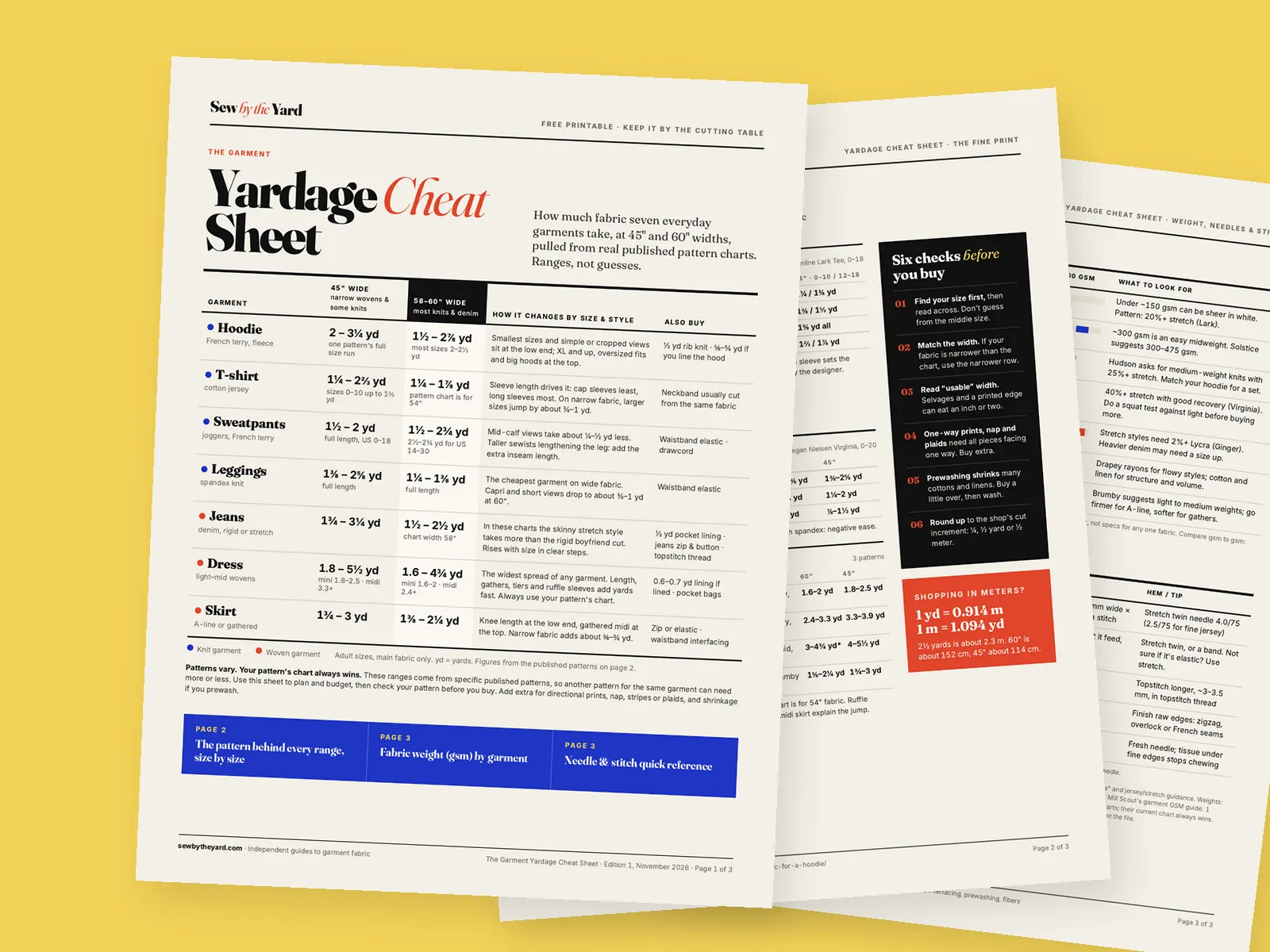
Join the Sew by the Yard newsletter and get The Garment Yardage Cheat Sheet: fabric amounts for seven garments at 45" and 60", a fabric-weight guide and a needle chart, on three printable pages.