How Much Fabric Do You Need for a T-Shirt?
Most adult T-shirts take about 1⅜ yards of 54–60" jersey; long sleeves 1⅔–1⅞ yd. Yardage chart by size, sleeve length and fabric width (44" vs 60").
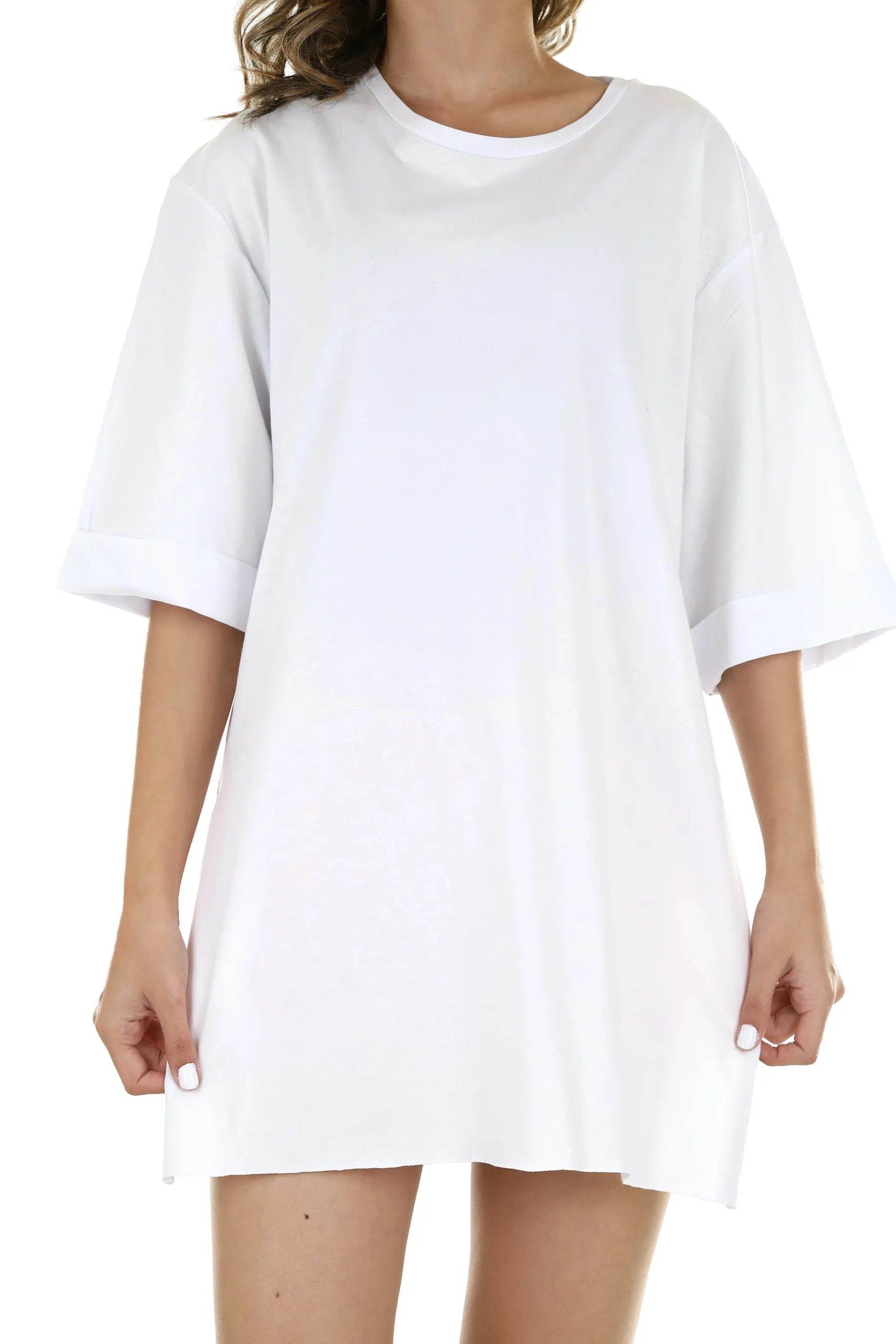
That’s a starting point, not a rule. The only number that really matters is the one printed on your pattern for your size and fabric width. Below is a chart from real published patterns so you can see how much yardage varies, followed by how to figure out your own number. For a comparison of T-shirt yardage with other garments and fabric widths, see the 2026 Sew by the Yard Yardage Index.
How much fabric does a T-shirt take, at a glance?
Smallest to largest size groups in each pattern’s own published chart. Short sleeves unless noted.
| Pattern | Fabric width | Smallest size | Largest size | Notes |
|---|---|---|---|---|
| Grainline Lark, short sleeve | 54” | 1⅜ yd (0–10) | 1⅓ yd (12–18) | Chart prints 1.3 m for all sizes |
| Grainline Lark, short sleeve | 44” | 1⅜ yd (0–10) | 2⅛ yd (12–18) | Narrow width jumps for larger sizes |
| Grainline Lark, long sleeve | 54” | 1⅔ yd (0–10) | 1⅞ yd (12–18) | Cap and ¾ also published |
| Grainline Lark, long sleeve | 44” | 1⅔ yd (0–10) | 2⅝ yd (12–18) | Long + narrow needs the most |
| Ourlette T-shirt (short, hip) | 150 cm / 60” | ~0.8 m (⅞ yd) | ~1.2 m (1⅜ yd) | Range across sizes and fits |
| Ourlette T-shirt (long sleeve) | 150 cm / 60” | ~1.5 m (1¾ yd) | ~1.9 m (2⅛ yd) | Longer sleeves add length |
| FreeSewingPattern Simple Knit Tee | 60” | 1.2 yd (XS–M) | 1.65 yd (2XL–3XL) | L–XL: 1.4 yd; 45” needs more |
Sources for every row are linked in the detailed charts below.
T-shirt yardage chart by size (from published patterns)
Every figure below is copied from the pattern’s own published fabric requirements. Follow the links to check them. Sizes are each pattern’s own size names, which don’t line up exactly from one brand to another.
Grainline Studio Lark Tee
From the Bolt & Spool Lark listing (also listed at The Fold Line). Bolt & Spool notes that all bodies need the same yardage; you choose the row by sleeve length. Sizes are Grainline’s US 0–18.
Short sleeve
| Fabric width | Sizes 0–10 | Sizes 12–18 |
|---|---|---|
| 54” | 1⅜ yd | 1⅓ yd |
| 44” | 1⅜ yd | 2⅛ yd |
Long sleeve
| Fabric width | Sizes 0–10 | Sizes 12–18 |
|---|---|---|
| 54” | 1⅔ yd | 1⅞ yd |
| 44” | 1⅔ yd | 2⅝ yd |
Cap and three-quarter sleeves (also published)
| Sleeve | 54” (0–10 / 12–18) | 44” (0–10 / 12–18) |
|---|---|---|
| Cap | 1¼ yd / 1⅜ yd | 1¼ yd / 2 yd |
| ¾ | 1⅝ yd / 1⅝ yd (all sizes) | 1⅝ yd / 2⅔ yd |
Ourlette T-shirt pattern
From the Ourlette T-shirt pattern page. Ourlette drafts to your measurements and computes exact quantity; the FAQ gives these ballpark ranges for 150 cm (60”) jersey:
- Short-sleeved, hip-length: usually 0.8–1.2 m (⅞–1⅜ yd)
- Long sleeves: about 1.5–1.9 m (1¾–2⅛ yd)
- Tunic length, oversized fit, or a larger size: add roughly 10–30 cm (4–12 in)
FreeSewingPattern Simple Knit Tee
From the Simple Knit Tee PDF fabric chart (60” fabric):
| Size | 60” fabric |
|---|---|
| XS–M | 1.2 yd |
| L–XL | 1.4 yd |
| 2XL–3XL | 1.65 yd |
The same PDF lists higher yardage for 45” fabric. Use that row if your jersey is narrower than 60”.
What the chart tells you
Across these patterns, adult short-sleeve tees on wide (54–60”) jersey cluster around about 1⅜ yards, with some charts a little under or over depending on size and fit. On 44–45” fabric, larger sizes can jump past 2 yards. Long sleeves commonly land near 1⅔–1⅞ yd on 54” fabric and higher on narrow fabric. If you don’t have a pattern yet and just want a ballpark, 1½ yards of 60” jersey covers most adult short-sleeve sizes in the charts above, with a little room for prewash shrinkage. Check your pattern before you cut.
The only number that really matters is the one printed on your pattern for your size and fabric width.
What changes how much fabric you need?
1. Fabric width
Width matters more than people expect. Lark’s short-sleeve chart shows it clearly: sizes 12–18 take 1⅓ yd on 54” but 2⅛ yd on 44”. Narrow fabric means pattern pieces can’t sit side by side, so you need more length.
Most jersey is sold around 58–60” wide, but quilting-cotton-width knits and some deadstock run closer to 44–45”. Always check the listing. If your fabric is narrower than the width your pattern lists, use the narrower-width row, or lay out your pieces on paper to measure.
2. Your size
In every chart above, bigger sizes need more fabric when the layout changes. On Lark at 54”, short-sleeve yardage barely moves between size groups; at 44”, it jumps. Look up your exact size and don’t guess from the middle.
3. Sleeve length and fit
Cap sleeves take the least fabric; long sleeves take the most. Oversized and drop-shoulder fits, tunic lengths, and deeper necklines all add length. Ourlette calls out tunic, oversized, and larger sizes as reasons to add a little beyond the short-sleeve hip-length range.
4. Shrinkage and directional fabric
- Prewashing: cotton jersey often shrinks a little in the first wash. Buying a bit extra gives you a buffer. See should you prewash fabric? for a quick shrinkage test.
- Nap and stripes: knits often look slightly different depending on which direction they’re cut, and stripes need matching. Many patterns use a “with nap” layout for knits. Matching stripes takes extra fabric beyond the chart.
How do you work out your exact yardage?
- Find your size on the pattern’s body measurement chart. Use your bust or chest measurement for a T-shirt.
- Find your fabric’s width on the listing. Use the row on the yardage chart that matches it, or the next narrower one.
- Read your number where your size, width, and sleeve length meet.
- Add extras: a small buffer for prewash shrinkage or stripe matching. The neckband is usually already included when it’s cut from the same jersey.
- Round up to the nearest quarter or half yard, depending on how your shop sells fabric.
Want it done for you? Our free fabric yardage calculator runs these steps for your size and fabric width, adds the nap, stripe-matching and shrinkage extras, and links every figure to its pattern chart. Prefer paper? Print the free fabric yardage chart (PDF, every garment by size).
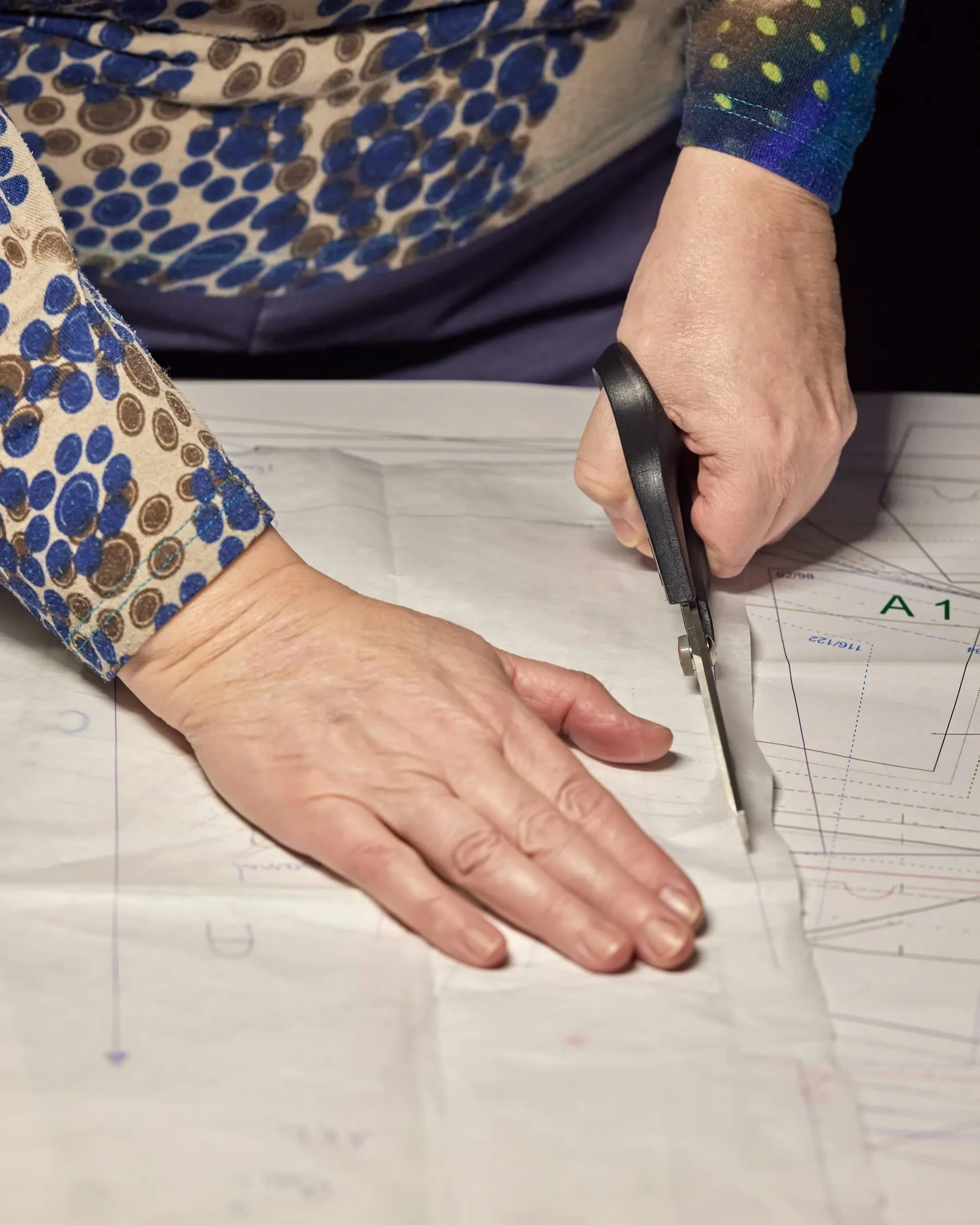
How much fabric for the neckband?
If your pattern cuts the neckband from the main fabric, you don’t buy extra for it. If you prefer a rib knit band, a scrap or a small cut (often under ¼ yard of rib) is enough for one crew neck. For the length formula and sewing steps, see how to sew a T-shirt neckband.
Buying for two tees or a matching set?
Don’t just double one tee’s yardage. Lay out both sets of pieces (on paper, or use the pattern’s layout diagrams), because pieces from two garments can sometimes share fabric width. A short-sleeve tee plus a long-sleeve view of the same pattern is a common combo where nesting saves fabric.
Free printables: record your bust and hip on our fill-in body measurement chart, and track fabric, yardage and notions with the one-page sewing project planner.
Worked example: what to buy for one T-shirt
Say you’re making Grainline Lark with short sleeves in size 8, on 60” cotton jersey (use the 54” row as the closest published width):
- Main fabric: 1⅜ yd (sizes 0–10, short sleeve, 54”)
- Neckband: included (cut from the same jersey)
- Buffer for prewashing: round up to 1½ yd
Total shopping list: about 1½ yards of 60” jersey. Switching to long sleeves on the same size and width? Lark lists 1⅔ yd, so round to 1¾ yd after a prewash buffer.
Making a hoodie instead? That takes more fabric; see how much fabric for a hoodie. Sewing jeans? See how much fabric for jeans.
What should you check before buying T-shirt fabric?
Jersey is easy to find online. Shops differ much more on width, stretch recovery, and whether you can return a cut, so check those things before you check out:
- Width: the charts above assume 44–45” or 54–60”. Use the matching row.
- Stretch: Lark calls for light to medium jersey with at least 20% stretch. Extra may be needed to match plaids, stripes, or one-way prints.
- Fiber: cotton/spandex blends recover better at the neckband than 100% cotton. For a full comparison, see the best fabric for T-shirts. Our fabric fiber guide explains what spandex does in a blend.
- Units: some shops sell by the yard, others by the half yard or half meter. Convert first: 1⅜ yards is about 1.3 meters.
- Returns: many shops treat cut fabric as final sale. Order a swatch if you’re unsure about weight or hand.
No serger? You can still sew a tee on a regular machine: see how to sew knits without a serger. For a ready-to-wear hem, use how to hem knits with a twin needle.
Common questions
How many yards of fabric do I need for a T-shirt?
Most adult short-sleeve T-shirts need about 1⅜ yards of 54–60” jersey. On 44–45” fabric, published charts run about 1⅜–2⅛ yd depending on size. Long sleeves need more. Your pattern’s chart is the final word.
How many meters of fabric do I need for a T-shirt?
On 150 cm (60”) jersey, Ourlette lists about 0.8–1.2 m for a short-sleeved hip-length tee and about 1.5–1.9 m with long sleeves. Grainline Lark’s short-sleeve chart prints 1.3 m for all sizes on 54” fabric. About 1.3–1.5 m covers most adult short-sleeve sizes on wide jersey.
How much fabric for a long-sleeve T-shirt?
More than a short-sleeve tee. Grainline Lark lists 1⅔ yd (sizes 0–10) or 1⅞ yd (12–18) on 54” fabric, and 1⅔ yd or 2⅝ yd on 44” fabric. Ourlette’s long-sleeve range on 60” jersey is about 1.5–1.9 m (1¾–2⅛ yd).
How much more fabric do I need if my fabric is 45 inches wide?
Often a lot more once you leave the smallest sizes. Lark’s short-sleeve chart jumps from 1⅜ yd (0–10) to 2⅛ yd (12–18) on 44” fabric, while the 54” row stays near 1⅓–1⅜ yd. Use the narrower-width row of your pattern’s chart.
How much fabric for an oversized T-shirt?
More than a fitted or regular tee, because the body and often the sleeves are bigger. Use your pattern’s chart for the oversized view. Ourlette notes that an oversized fit can add roughly 10–30 cm beyond its short-sleeve hip-length range. If you’re sizing up a regular pattern, use the yardage for the size you’re actually cutting.
Can I make a T-shirt with 1 yard of fabric?
Sometimes, on wide fabric and a smaller size or cropped view. FreeSewingPattern lists 1.2 yd for XS–M on 60”, and Ourlette’s short-sleeve range starts around 0.8 m (⅞ yd). Adult long sleeves and narrow fabric usually need more than 1 yard. Color-blocking sleeves from a second fabric is another way to stretch a short cut.
What fabric should I use for a T-shirt?
Light to medium jersey with good recovery, ideally with a little spandex for the neckband. Our best fabric for T-shirts guide compares jersey, interlock, blends and weights. See our fabric fiber guide for cotton, rayon and stretch blends, and should you prewash fabric? before you cut. For the neck finish, see how to sew a T-shirt neckband.
Sources
- Bolt & Spool: Grainline Studio Lark Tee (fabric requirements by sleeve and width)
- The Fold Line: Grainline Studio Lark Tee (pattern listing)
- Ourlette: T-shirt sewing pattern (short- and long-sleeve yardage ranges on 150 cm jersey)
- FreeSewingPattern: Simple Knit Tee PDF (60” yardage by size group)
Free printable · The newsletter
Never guess yardage again.
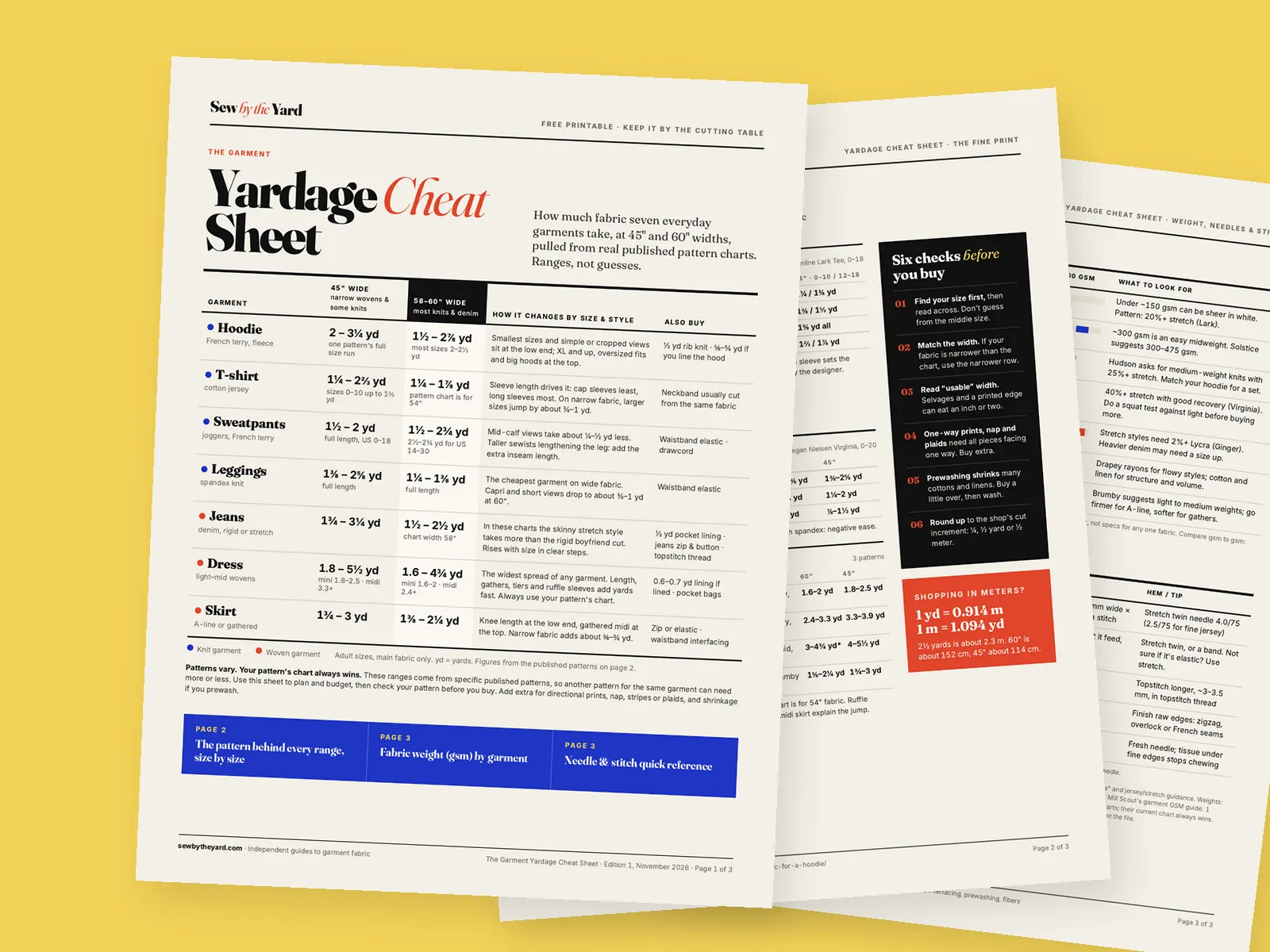
Join the Sew by the Yard newsletter and get The Garment Yardage Cheat Sheet: fabric amounts for seven garments at 45" and 60", a fabric-weight guide and a needle chart, on three printable pages.